
Lombard, IL · Garage Door Service
Wind, Wide Doors, and Lombard's Older Garage Stock
Lombard's double-car doors date mostly to the 1960s-70s building wave. Here's what cold-climate wind stress actually does to that original hardware over time.
- Repairs & new doors
- Springs & openers
- Serving 8 nearby communities
What Is Going On
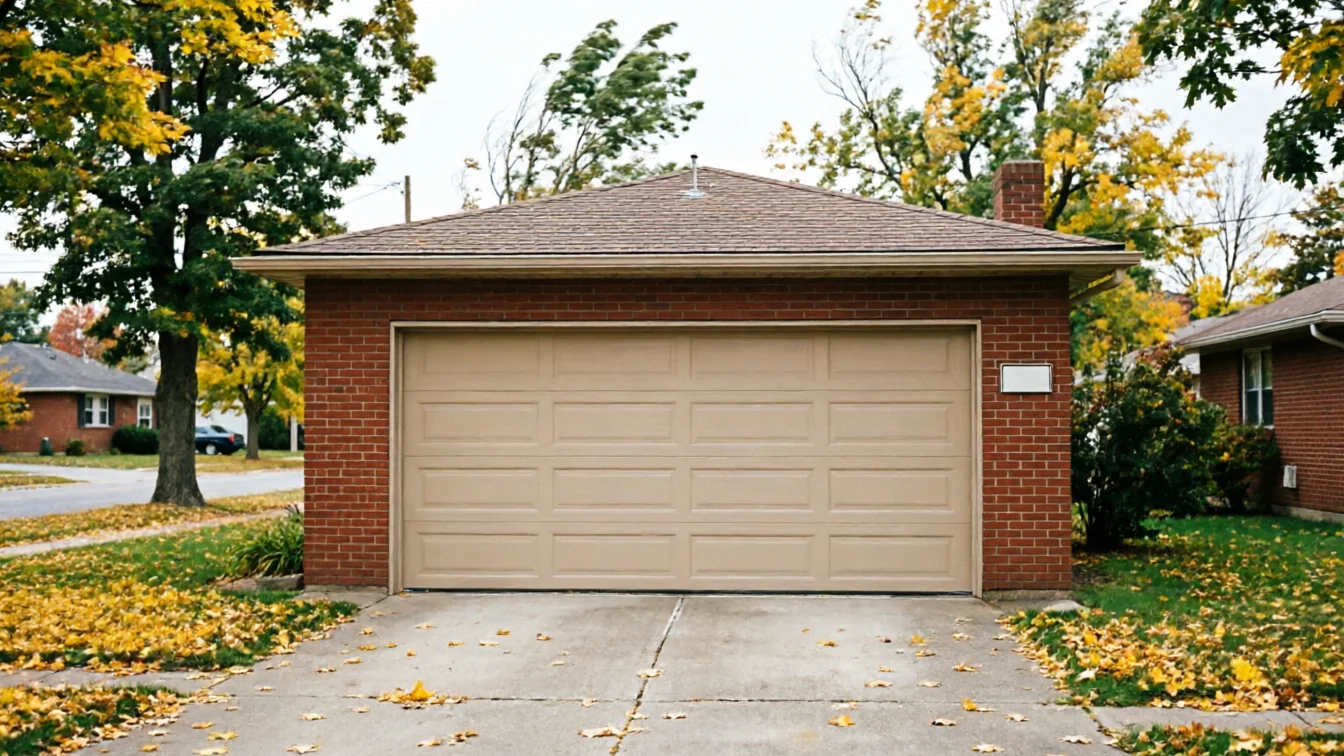
Most houses on this side of DuPage County went up between 1938 and 1998, with the median landing at 1973. That matters for garage doors because a double-car door built in that era is a different animal from what goes in today. The wide ones - 16 feet across, single piece or sectional without a heavy center strut - were built to the standard of their decade, which did not include the wind-load bracing codes require now. Add fifty years of use and the hardware on a lot of these doors is original: same track, same end bearing plates, sometimes the same spring. None of that was built with gusts hitting a flat 16-foot panel in mind.
A single door, 8 or 9 feet wide, handles wind differently. The surface area pushing back is smaller and the frame doesn't flex the same way. Wide doors are a different load problem entirely, and in this part of Lombard, wide doors on original hardware are common, not rare.
This isn't a defect. It's just what a 50-year-old door does under a load nobody engineered it for.
What Local Conditions Do
Lombard sits in a cold, moderate climate band. That means the doors here aren't fighting one hard winter - they're fighting repeated cycles of a mild afternoon followed by an overnight freeze, year after year. Steel panels expand and contract with that swing. On a wide door, the center meeting rail - where two panel halves or a center strut join - is the first place that movement shows up, because it's the seam carrying the most unsupported span.
Pair that metal fatigue with wind pushing laterally on the face of the door and the center joint is doing double duty: absorbing thermal flex and resisting a gust at the same time. On the builder-grade doors common from the 1960s-70s wave of construction across this area, that center point often has the least reinforcement of anywhere on the door. It's usually where a wide door fails first - not at the tracks, not at the springs, but right at the middle where the two halves meet.
A single door doesn't have that seam to begin with, which is part of why wide doors show wind-related wear that narrow ones in the same neighborhood don't.
Doing Nothing For Now
If your door is a wide double from that original building era and it's still tracking straight, closing flush, and not visibly bowing in a gust, you don't need to do anything today. A lot of these doors ride out normal wind for years with no trouble - steel is forgiving until it isn't.
What's worth watching: daylight at the center seam when the door is closed, a panel that visibly flexes inward when wind hits it from outside, or a track that's started to pull away from the jamb on one side. Those are the signs the center joint is losing its fight, not a reason to panic the first time you notice the door move a little in a gust - some flex is normal on any sectional door.
Honest limitation: we can't tell you from a description over the phone whether your door's flex is normal aging or a structural problem. That's a look-at-it-in-person call, because the difference between
Related garage door services in Lombard
More garage door guides
Book garage door service in Lombard
Call now or request a quote - tell us what the door is doing and where you are.